
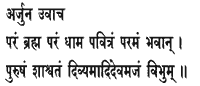
Arjuna said: Thou art the supreme Brahman, the supreme Abode, the supreme Purity, the one permanent, the divine Purusha, the original Godhead, the Unborn, the all-pervading Lord.
The Vision of the World-Spirit -Time the Destroyer
Sri Aurobindo
THE VISION of the universal Purusha is one of the best known and most powerfully poetic passages in the Gita, but its place in the thought is not altogether on the surface. It is evidently intended for a poetic and revelatory symbol and we must see how it is brought in and for what purpose and discover to what it points in its significant aspects before we can capture its meaning. It is invited by Arjuna in his desire to see the living image, the visible greatness of the unseen Divine, the very embodiment of the Spirit and Power that governs the universe. He has heard the highest spiritual secret of existence, that all is from God and all is the Divine and in all things God dwells and is concealed and can be revealed in every finite appearance. The illusion which so persistently holds man’s sense and mind, the idea that things at all exist in themselves or for themselves apart from God or that anything subject to Nature can be self-moved and self-guided, has passed from him,—thatwas the cause of his doubt and bewilderment and refusal of action. Now he knows what is the sense of the birth and passing away of existences. He knows that the imperishable greatness of the divine conscious Soul is the secret of all these appearances. All is a Yoga of this great eternal Spirit in things and all happenings are the result and expression of that Yoga; all Nature is full of the secret Godhead and in labour to reveal him in her. But he would see too the very form and body of this Godhead, if that be possible. He has heard of his attributes and understood the steps and ways of his self-revelation; but now he asks of this Master of the Yoga to discover his very imperishable Self to the eye of Yoga. Not, evidently, the formless silence of his actionless immutability, but the Supreme from whom is all energy and action, of whom forms are the masks, who reveals his force in the Vibhuti,—the Master of works, the Master of knowledge and adoration, the Lord of Nature and all her creatures. For this greatest all-comprehending vision he is made to ask because it is so, from the Spirit revealed in the universe, that he must receive the command to his part in the world-action. What thou hast to see, replies the Avatar, the human eye cannot grasp,—for the human eye can see only the outward appearances of things or make out of them separate symbol forms, each of them significant of only a few aspects of the eternal Mystery. But there is a divine eye, an inmost seeing, by which the supreme Godhead in his Yoga can be beheld and that eye I now give to thee. Thou shalt see, he says, my hundreds and thousands of divine forms, various in kind, various in shape and hue; thou shalt see the Adityas and the Rudras and the Maruts and the Aswins; thou shalt see many wonders that none has beheld; thou shalt see today the whole world related and unified in my body and whatever else thou willest to behold. This then is the keynote, the central significance. It is the vision of the One in the many, the Many in the One,—and all are the One. It is this vision that to the eye of the divine Yoga liberates, justifies, explains all that is and was and shall be. Once seen and held, it lays the shining axe of God at the root of all doubts and perplexities and annihilates all denials and oppositions. It is the vision that reconciles and unifies. If the soul can arrive at unity with the Godhead in this vision,—Arjuna has not yet done that, therefore we find that he has fear when he sees,—all even that is terrible in the world loses its terror. We see that it too is an aspect of the Godhead and once we have found his meaning in it, not looking at it by itself alone, we can accept the whole of existence with an all-embracing joy and a mighty courage, go forward with sure steps to the appointed work and envisage beyond it the supreme consummation. The soul admitted to the divine knowledge which beholds all things in one view, not with a divided, partial and therefore bewildered seeing, can make a new discovery of the world and all else that it wills to see, yac c ¯anyad dras.t. um icchasi; it can move on the basis of this all relating and all-unifying vision from revelation to completing revelation. The supreme Form is then made visible. It is that of the infinite Godhead whose faces are everywhere and in whom are all the wonders of existence, who multiplies unendingly all the many marvellous revelations of his being, a world-wide Divinity seeing with innumerable eyes, speaking from innumerable mouths, armed for battle with numberless divine uplifted weapons, glorious with divine ornaments of beauty, robed in heavenly raiment of deity, lovely with garlands of divine flowers, fragrant with divine perfumes. Such is the light of this body of God as if a thousand suns had risen at once in heaven. The whole world multitudinously divided and yet unified is visible in the body of the God of Gods. Arjuna sees him, God magnificent and beautiful and terrible, the Lord of souls who has manifested in the glory and greatness of his spirit this wild and monstrous and orderly and wonderful and sweet and terrible world, and overcome with marvel and joy and fear he bows down and adores with words of awe and with clasped hands the tremendous vision. “I see” he cries “all the gods in thy body, O God, and different companies of beings, Brahma the creating lord seated in the Lotus, and the Rishis and the race of the divine Serpents. I see numberless arms and bellies and eyes and faces, I see thy infinite forms on every side, but I see not thy end nor thy middle nor thy beginning, O Lord of the universe, O Form universal. I see thee crowned and with thy mace and thy discus, hard to discern because thou art a luminous mass of energy on all sides of me, an encompassing blaze, a sun-bright fire-bright Immeasurable. Thou art the supreme Immutable whom we have to know, thou art the high foundation and abode of the universe, thou art the imperishable guardian of the eternal laws, thou art the sempiternal soul of existence.” But in the greatness of this vision there is too the terrific image of the Destroyer. This Immeasurable without end or middle or beginning is he in whom all things begin and exist and end. This Godhead who embraces the worlds with his numberless arms and destroys with his million hands, whose eyes are suns and moons, has a face of blazing fire and is ever burning up the whole universe with the flame of his energy. The form of him is fierce and marvellous and alone it fills all the regions and occupies the whole space between earth and heaven. The companies of the gods enter it, afraid, adoring; the Rishis and the Siddhas crying “May there be peace and weal” praise it with many praises; the eyes of Gods and Titans and Giants are fixed on it in amazement. It has enormous burning eyes; it has mouths that gape to devour, terrible with many tusks of destruction; it has faces like the fires of Death and Time. The kings and the captains and the heroes on both sides of the world-battle are hastening into its tusked and terrible jaws and some are seen with crushed and bleeding heads caught between its teeth of power; the nations are rushing to destruction with helpless speed into its mouths of flame like many rivers hurrying in their course towards the ocean or like moths that cast themselves on a kindled fire. With those burning mouths the Form of Dread is licking all the regions around; the whole world is full of his burning energies and baked in the fierceness of his lustres. The world and its nations are shaken and in anguish with the terror of destruction and Arjuna shares in the trouble and panic around him; troubled and in pain is the soul within him and he finds no peace or gladness. He cries to the dreadful Godhead, “Declare to me who thou art that wearest this form of fierceness. Salutation to thee, O thou great Godhead, turn thy heart to grace. I would know who thou art who wast from the beginning, for I know not the will of thy workings.” This last cry of Arjuna indicates the double intention in the vision. This is the figure of the supreme and universal Being, the Ancient of Days who is for ever, sana¯tanam˙ purus.am˙ pura¯n.am, this is he who for ever creates, for Brahma the Creator is one of the Godheads seen in his body, he who keeps the world always in existence, for he is the guardian of the eternal laws, but who is always too destroying in order that he may new-create, who is Time, who is Death, who is Rudra the Dancer of the calm and awful dance, who is Kali with her garland of skulls trampling naked in battle and flecked with the blood of the slaughtered Titans, who is the cyclone and the fire and the earthquake and pain and famine and revolution and ruin and the swallowing ocean. And it is this last aspect of him which he puts forward at the moment. It is an aspect from which themind inmen willingly turns away and ostrich-like hides its head so that perchance, not seeing, it may not be seen by the Terrible. The weakness of the human heart wants only fair and comforting truths or in their absence pleasant fables; it will not have the truth in its entirety because there there is much that is not clear and pleasant and comfortable, but hard to understand and harder to bear. The raw religionist, the superficial optimistic thinker, the sentimental idealist, the man at the mercy of his sensations and emotions agree in twisting away from the sterner conclusions, the harsher and fiercer aspects of universal existence. Indian religion has been ignorantly reproached for not sharing in this general game of hiding, because on the contrary it has built and placed before it the terrible as well as the sweet and beautiful symbols of the Godhead. But it is the depth and largeness of its long thought and spiritual experience that prevent it from feeling or from giving countenance to these feeble shrinkings. Indian spirituality knows that God is Love and Peace and calm Eternity,—the Gita which presents us with these terrible images, speaks of the Godhead who embodies himself in them as the lover and friend of all creatures. But there is too the sterner aspect of his divine government of the world which meets us from the beginning, the aspect of destruction, and to ignore it is to miss the full reality of the divine Love and Peace and Calm and Eternity and even to throw on it an aspect of partiality and illusion, because the comforting exclusive form in which it is put is not borne out by the nature of the world in which we live. This world of our battle and labour is a fierce dangerous destructive devouring world in which life exists precariously and the soul and body of man move among enormous perils, a world in which by every step forward, whether we will it or no, something is crushed and broken, in which every breath of life is a breath too of death. To put away the responsibility for all that seems to us evil or terrible on the shoulders of a semi-omnipotent Devil, or to put it aside as part of Nature, making an unbridgeable opposition between world-nature and God-Nature, as if Nature were independent of God, or to throw the responsibility on man and his sins, as if he had a preponderant voice in the making of this world or could create anything against the will of God, are clumsily comfortable devices in which the religious thought of India has never taken refuge. We have to look courageously in the face of the reality and see that it is God and none else who has made this world in his being and that so he has made it. We have to see that Nature devouring her children, Time eating up the lives of creatures, Death universal and ineluctable and the violence of the Rudra forces in man and Nature are also the supreme Godhead in one of his cosmic figures. We have to see that God the bountiful and prodigal creator, God the helpful, strong and benignant preserver is also God the devourer and destroyer. The torment of the couch of pain and evil on which we are racked is his touch as much as happiness and sweetness and pleasure. It is only when we see with the eye of the complete union and feel this truth in the depths of our being that we can entirely discover behind that mask too the calm and beautiful face of the all-blissful Godhead and in this touch that tests our imperfection the touch of the friend and builder of the spirit in man. The discords of the worlds are God’s discords and it is only by accepting and proceeding through them that we can arrive at the greater concords of his supreme harmony, the summits and thrilled vastnesses of his transcendent and his cosmic Ananda. The problem raised by the Gita and the solution it gives demand this character of the vision of the World-Spirit. It is the problem of a great struggle, ruin and massacre which has been brought about by the all-guiding Will and in which the eternal Avatar himself has descended as the charioteer of the protagonist in the battle. The seer of the vision is himself the protagonist, the representative of the battling soul of man who has to strike down tyrant and oppressive powers that stand in the path of his evolution and to establish and enjoy the kingdom of a higher right and nobler law of being. Perplexed by the terrible aspect of the catastrophe in which kindred smite at kindred, whole nations are to perish and society itself seems doomed to sink down in a pit of confusion and anarchy, he has shrunk back, refused the task of destiny and demanded of his divine Friend and Guide why he is appointed to so dreadful a work, ki ˙ m karman. i ghore ma¯m˙ niyojayasi. He has been shown then how individually to rise above the apparent character of whatever work he may do, to see that Nature the executive force is the doer of the work, his natural being the instrument, God the master of Nature and of works to whom he must offer them without desire or egoistic choice as a sacrifice. He has been shown too that the Divine who is above all these things and untouched by them, yet manifests himself in man and Nature and their action and that all is a movement in the cycles of this divine manifestation. But now when he is put face to face with the embodiment of this truth, he sees in it magnified by the image of the divine greatness this aspect of terror and destruction and is appalled and can hardly bear it. For why should it be thus that the All-spirit manifests himself in Nature? What is the significance of this creating and devouring flame that is mortal existence, this worldwide struggle, these constant disastrous revolutions, this labour and anguish and travail and perishing of creatures? He puts the ancient question and breathes the eternal prayer, “Declare to me who art thou that comest to us in this form of fierceness. I would know who art thou who wast from the beginning, for I know not the will of thy workings. Turn thy heart to grace.” Destruction, replies the Godhead, is the will of my workings with which I stand here on this field of Kurukshetra, the field of the working out of the Dharma, the field of human action,—as we might symbolically translate the descriptive phrase, dharmaks. etre kuru-ks.etre,—a world-wide destruction which has come in the process of the Time-Spirit. I have a foreseeing purpose which fulfils itself infallibly and no participation or abstention of any human being can prevent, alter or modify it; all is done by me already in my eternal eye of will before it can at all be done by man upon earth. I as Time have to destroy the old structures and to build up a new, mighty and splendid kingdom. Thou as a human instrument of the divine Power and Wisdom hast in this struggle which thou canst not prevent to battle for the right and slay and conquer its opponents. Thou too, the human soul in Nature, hast to enjoy in Nature the fruit given by me, the empire of right and justice. Let this be sufficient for thee,—to be one with God in thy soul, to receive his command, to do his will, to see calmly a supreme purpose fulfilled in the world. “I am Time the waster of the peoples arisen and increased whose will in my workings is here to destroy the nations. Even without thee all these warriors shall be not, who are ranked in the opposing armies. Therefore arise, get thee glory, conquer thy enemies and enjoy an opulent kingdom. By me and none other already even are they slain, do thou become the occasion only,OSavyasachin. Slay, by me who are slain, Drona, Bhishma, Jayadratha, Karna and other heroic fighters; be not pained and troubled. Fight, thou shalt conquer the adversary in the battle.” The fruit of the great and terrible work is promised and prophesied, not as a fruit hungered for by the individual,—for to that there is to be no attachment,—but as the result of the divine will, the glory and success of the thing to be done accomplished, the glory given by the Divine to himself in his Vibhuti. Thus is the final and compelling command to action given to the protagonist of the world-battle. It is the Timeless manifest as Time and World-Spirit from whom the command to action proceeds. For certainly the Godhead when he says, “I am Time the Destroyer of beings,” does not mean either that he is the Time-Spirit alone or that the whole essence of the Time-Spirit is destruction. But it is this which is the present will of his workings, pravr.tti. Destruction is always a simultaneous or alternate element which keeps pace with creation and it is by destroying and renewing that the Master of Life does his long work of preservation. More, destruction is the first condition of progress. Inwardly, the man who does not destroy his lower self-formations, cannot rise to a greater existence. Outwardly also, the nation or community or race which shrinks too long from destroying and replacing its past forms of life, is itself destroyed, rots and perishes and out of its debris other nations, communities and races are formed. By destruction of the old giant occupants man made himself a place upon earth. By destruction of the Titans the gods maintain the continuity of the divine Law in the cosmos. Whoever prematurely attempts to get rid of this law of battle and destruction, strives vainly against the greater will of theWorld-Spirit. Whoever turns from it in the weakness of his lower members, as did Arjuna in the beginning,—therefore was his shrinking condemned as a small and false pity, an inglorious, an un-Aryan and unheavenly feebleness of heart and impotence of spirit, klaibyam, ks.udram˙ hr.daya-daurbalyam,—is showing not true virtue, but a want of spiritual courage to face the sterner truths of Nature and of action and existence. Man can only exceed the law of battle by discovering the greater law of his immortality. There are those who seek this where it always exists and must primarily be found, in the higher reaches of the pure spirit, and to find it turn away from a world governed by the law of Death. That is an individual solution which makes no difference to mankind and the world, or rather makes only this difference that they are deprived of so much spiritual power which might have helped them forward in the painful march of their evolution. What then is the master man, the divine worker, the opened channel of the universal Will to do when he finds the World- Spirit turned towards some immense catastrophe, figured before his eyes as Time the destroyer arisen and increased for the destruction of the nations, and himself put there in the forefront whether as a fighter with physical weapons or a leader and guide or an inspirer of men, as he cannot fail to be by the very force of his nature and the power within him, svabh¯avajena svena karman. ¯a? To abstain, to sit silent, to protest by nonintervention? But abstention will not help, will not prevent the fulfilment of the destroyingWill, but rather by the lacuna it creates increase confusion. Even without thee, cries the Godhead, my will of destruction would still be accomplished,r. te’pi tv¯am. If Arjuna were to abstain or even if the battle of Kurukshetra were not to be fought, that evasion would only prolong and make worse the inevitable confusion, disorder, ruin that are coming. For these things are no accident, but an inevitable seed that has been sown and a harvest that must be reaped. They who have sown the wind, must reap the whirlwind. Nor indeed will his own nature allow him any real abstention, prakr.tis tva¯m˙ niyoks.yati. This the Teacher tells Arjuna at the close, “That which in thy egoism thou thinkest saying, I will not fight, vain is this thy resolve: Nature shall yoke thee to thy work. Bound by thy own action which is born of the law of thy being, what from delusion thou desirest not to do, that thou shalt do even perforce.” Then to give another turn, to use some kind of soul force, spiritual method and power, not physical weapons? But that is only another form of the same action; the destruction will still take place, and the turn given too will be not what the individual ego, but what the World-Spirit wills. Even, the force of destruction may feed on this new power, may get a more formidable impetus and Kali arise filling the world with a more terrible sound of her laughters. No real peace can be till the heart of man deserves peace; the law of Vishnu cannot prevail till the debt to Rudra is paid. To turn aside then and preach to a still unevolved mankind the law of love and oneness? Teachers of the law of love and oneness there must be, for by that way must come the ultimate salvation. But not till the Time-Spirit in man is ready, can the inner and ultimate prevail over the outer and immediate reality. Christ and Buddha have come and gone, but it is Rudra who still holds the world in the hollow of his hand. Andmeanwhile the fierce forward labour of mankind tormented and oppressed by the Powers that are profiteers of egoistic force and their servants cries for the sword of the Hero of the struggle and the word of its prophet. The highest way appointed for him is to carry out the will of God without egoism, as the human occasion and instrument of that which he sees to be decreed, with the constant supporting memory of the Godhead in himself and man, m¯am anusmaran, and in whatever ways are appointed for him by the Lord of his Nature. Nimittama¯ tram˙ bhava savyasa¯cin. He will not cherish personal enmity, anger, hatred, egoistic desire and passion, will not hasten towards strife or lust after violence and destruction like the fierce Asura, but he will do his work, lokasan˙ graha¯ya. Beyond the action he will look towards that to which it leads, that for which he is warring. For God the Time-Spirit does not destroy for the sake of destruction, but to make the ways clear in the cyclic process for a greater rule and a progressing manifestation, r ¯ ajya ˙ m samr. ddham. He will accept in its deeper sense, which the superficial mind does not see, the greatness of the struggle, the glory of the victory,—if need be, the glory of the victory which comes masked as defeat,—and lead man too in the enjoyment of his opulent kingdom. Not appalled by the face of the Destroyer, he will see within it the eternal Spirit imperishable in all these perishing bodies and behind it the face of the Charioteer, the Leader of man, the Friend of all creatures, suhr.dam˙ sarvabhu¯ ta¯na¯m. This formidable World- Form once seen and acknowledged, it is to that reassuring truth that the rest of the chapter is directed; it discloses in the end a more intimate face and body of the Eternal.
Sri Aurobindo
 About Us| ©1999 - 2009 searchforlight.org
All extracts and quotations from the written works of Sri Aurobindo and the Mother and the Photographs of
the Mother and Sri Aurobindo are copyright Sri Aurobindo Ashram Trust, Pondicherry -605002 India.